
The OECD warns that Spain has one of the lowest water price in Europe, a situation that does not match to its water scarcity. Farmers respond that it is "impossible" to assume a price increase. The UN rapporteur indicates that the first thing is to ensure adequate water governance in the country.
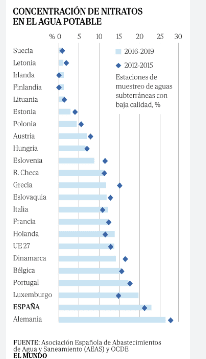
Fig. 1 Nitrate concentration in drinking water (source: El Mundo)
The bill that households pay for water
Although the OECD document is more oriented towards problems and prices in agricultural water use, the sectoral organization AEAS also recently pointed to the water bills paid by Spanish households. "The average price of water for domestic use in Spain is 1.97 €/m3 (excluding VAT). (Fig. 2) This price is far from covering the cost of services, contrary to the requirements set by the Water Framework Directive". "Spain has one of the lowest urban water tariffs (which includes domestic, industrial and commercial use) in Europe. We are 45% below the European average despite being one of the European countries with the greatest scarcity of water resource".
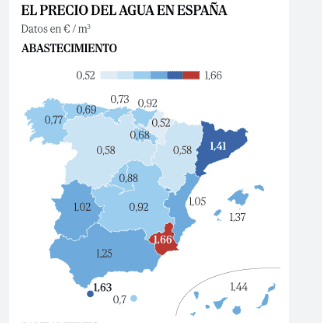
Fig. 2 The price of water in Spain (source: El Mundo)
The consequences
But what would be the consequences of raising the price of the water bill?. "It is impossible to assume that," says Pedro Barato, president of the farmers' association Asaja. In his opinion, "we must start with other measures before addressing a possible increase in the price of water". "In the end what we are going to do is scare off investments and endanger the economy of an area," he complains.
The problem lies in the fact that irrigation is much more profitable than rainfed farming. According to data provided by Asaja, in Spain there are around 3.5 million hectares of irrigated land and 11.5 million of rainfed, however the value of the production of the first is much higher. According to Mr. Barato, "either water has a political price or it is impossible to develop agricultural activities". This is the case, for example, with desalinization, discarded by the OECD to solve the aforementioned problem of nitrates in aquifers. "It will work for a golf course, because it is profitable, but not for tomato cultivation," says Barato.
For this farmers' representative, the alternative is to dispose of nitrites and nitrates as is already being done, with circular economy solutions, such as biogas production. This could be complemented with the neglect of functions that he assures that exists with recycled water. "There are many more things that can be done than quickly raising the price of water".